


There is a tendency in rapidly growing cities to mistake scale for significance.
A taller building arrives. A larger investment is announced. Fresh renderings emerge with glass façades, rooftop terraces and carefully positioned palm trees. The assumption follows that the city has somehow advanced.
Yet architecture rarely works that way.
The true test of a building is not whether it dominates a skyline but whether it improves the experience of the city around it.
That question hangs over The SANA, a proposed US$25 million mixed use development now taking shape along Kingston’s South Avenue corridor. Developed by MoneyMasters REIF South Development Limited, the project promises a combination of retail, entertainment, office space and luxury penthouse residences. On paper, it is ambitious. In its renderings, it is even more so.
What emerges from those images is a project that appears determined to distinguish itself from the increasingly familiar language of Caribbean commercial development.
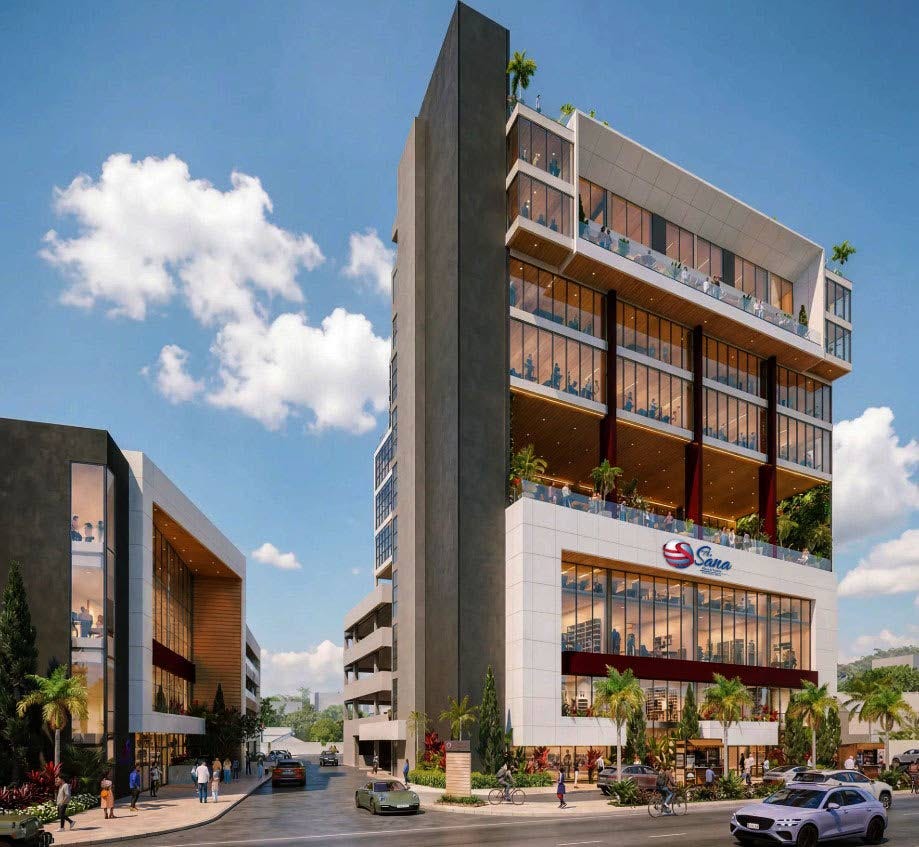
The tower is the focal point.
Rather than presenting itself as a simple glass office block, it adopts a layered composition. Floors are expressed individually, terraces are pulled forward and recessed, and a dramatic vertical concrete spine anchors the structure visually. The effect is a building that feels assembled rather than extruded. There is weight and hierarchy to the composition.
This is perhaps the most successful aspect of the design.
Too many contemporary commercial buildings rely on glass as a substitute for architectural character. The SANA attempts something different. It creates shadow, depth and texture. In a tropical climate where sunlight is often relentless, these decisions are more than aesthetic. They influence how a building feels throughout the day.
The tower’s stepped profile also introduces a degree of visual drama that is still relatively uncommon in Kingston’s commercial architecture. Seen from the street, the building is likely to command attention without resorting to excessive ornamentation.
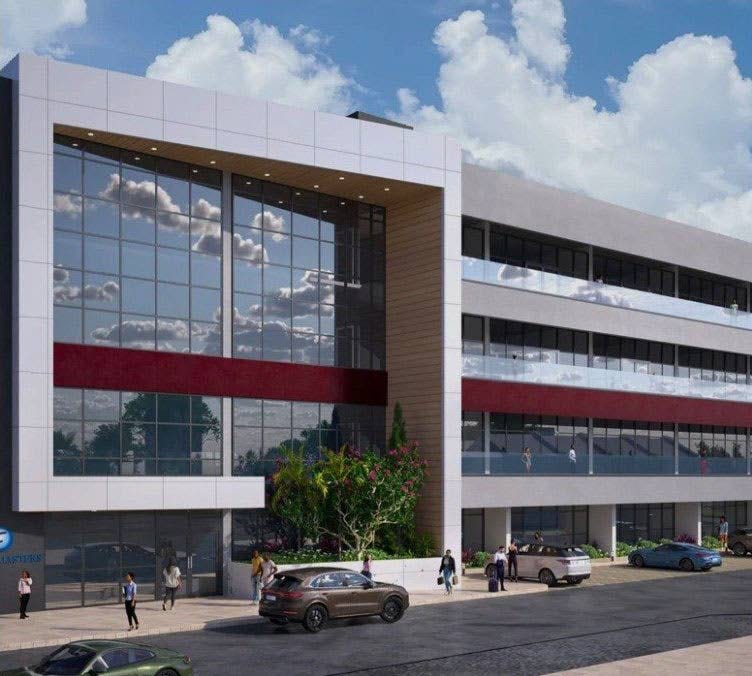
The accompanying plaza building is more restrained.
Its architecture is defined by horizontal lines, expansive glazing and a large recessed entrance framed by white cladding. It is competent and contemporary, though arguably less distinctive than the tower itself. If the tower aspires to become a landmark, the plaza serves as its supporting structure, providing balance rather than spectacle.
Together they create a development that feels influenced by contemporary projects found in Miami, Panama City and parts of Colombia. That observation should not be mistaken for criticism. Kingston increasingly operates within a global architectural conversation, and The SANA appears comfortable participating in it.
The material palette reinforces this international sensibility.
White panel systems, dark structural elements, extensive glazing and warm timber toned surfaces create a visual language associated with premium commercial real estate. It is a palette that communicates confidence and professionalism. Importantly, it avoids some of the visual clutter that can diminish newer developments.
Whether those ambitions survive construction will depend on execution.
Architectural renderings are exercises in optimism. Materials appear flawless. Landscaping is mature. Public spaces are filled with carefully dressed pedestrians enjoying ideal weather. The challenge for every development is translating that vision into reality.
If The SANA is delivered with the quality suggested by its renderings, it could become one of Kingston’s more visually refined commercial projects. If corners are cut, many of the qualities that currently distinguish it could quickly disappear.
More interesting than the architecture itself, however, is what the project suggests about the direction of Kingston.
For decades, commercial development in the city has largely been defined by separation. Offices occupied one building. Retail occupied another. Entertainment was found elsewhere. Residential communities often existed entirely apart from economic activity.
The SANA proposes a different model.
Its programme places commercial activity on the lower floors, restaurants and entertainment above, corporate offices higher still and residential penthouses at the top. It reflects a global shift towards developments that blur traditional boundaries between working, living and socialising.
The question is whether Kingston is ready to embrace that model fully.
There is evidence that it may be.
The South Avenue corridor already functions as one of the capital’s most active commercial districts. Financial institutions, professional services, restaurants and medical facilities have created a destination that attracts visitors from across the island. In that context, The SANA is not attempting to create a new district. It is attempting to intensify an existing one.
That distinction matters.
Many mixed use developments fail because they are built in locations that lack the critical mass required to support them. The SANA benefits from entering a corridor where economic activity already exists.
Yet certain questions remain.
The residential component consists of only two penthouse residences. They are luxurious by local standards and occupy the uppermost floors of the tower, but they do not fundamentally transform the project into a residential destination. In practical terms, this remains overwhelmingly a commercial development with a residential flourish at its summit.
Likewise, the proposed entertainment and restaurant level introduces an intriguing but untested dimension. Kingston’s most successful dining destinations generally maintain a direct relationship with the street. Convincing patrons to travel vertically through a commercial tower will require exceptional operators and thoughtful management.
Architecture can create opportunity. It cannot create culture on its own.
Still, there is much to admire.
The project demonstrates a clear understanding that contemporary commercial buildings must offer more than office space. Tenants increasingly seek environments that provide convenience, flexibility and identity. Workers expect access to dining and social spaces. Investors expect long term relevance. Developers are beginning to recognise that buildings compete not only on location but also on experience.
The SANA appears designed with that reality in mind.
Perhaps its greatest achievement is that it introduces a sense of optimism without descending into excess.
The architecture is ambitious but not flamboyant. Modern but not aggressively futuristic. It acknowledges international influences while remaining grounded in Kingston’s commercial landscape.
Whether it ultimately succeeds will depend on factors beyond architecture. Leasing strategies, tenant selection, property management and market conditions will all play decisive roles.
But architecture often provides the first indication of a project’s aspirations.
Viewed through that lens, The SANA represents an important moment in Kingston’s evolution. Not because it is the tallest building. Not because it is the most expensive. But because it asks a larger question about what the next generation of urban development in Jamaica should look like.
The answer, for now, remains under construction.