

The Sand Is Disappearing From Jamaica’s Beaches
From Hellshire to once-thriving shorelines, erosion, development, and neglect are closing the gap between sea and home—raising urgent questions about protection, value, and whether Jamaica is prepared


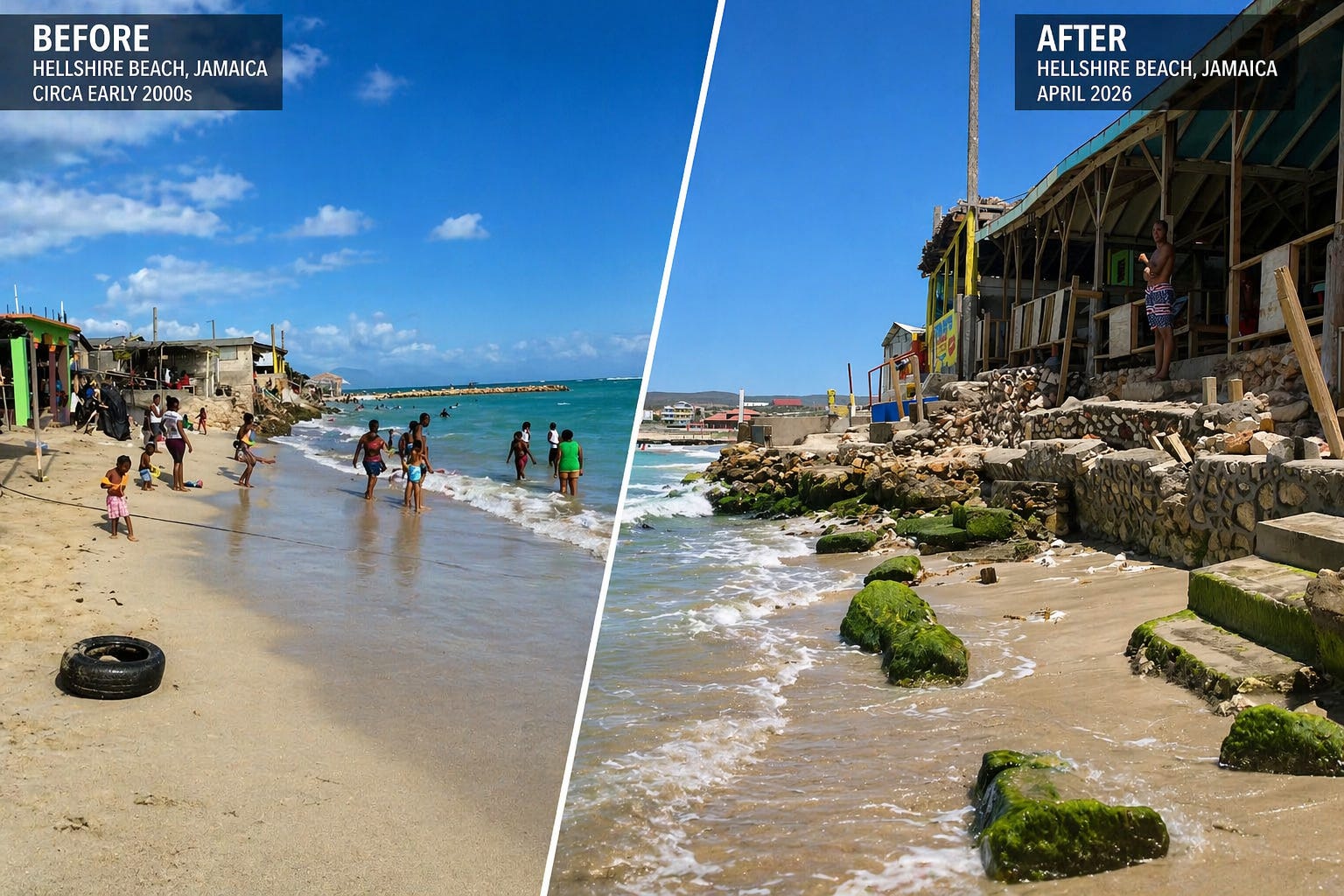
Beaches that once defined community life are shrinking rapidly, with the sea now reaching structures that once sat safely inland
Coastal erosion is being driven by a mix of climate pressure, unregulated shoreline development, and human activity
Loss of sand is increasing flood risk and exposing nearby homes and infrastructure to long-term damage
Informal construction and sand displacement are accelerating the breakdown of natural coastal protection systems
Global projects, including large-scale beach restoration efforts in Brazil, show that rebuilding coastlines is possible with strategic investment
Dean Jones warns that the disappearance of beaches is not just environmental, but a direct threat to property value, community stability, and Jamaica’s economic future
There was a time when the sand came first.
Before the stalls, before the timber frames, before the slow encroachment of makeshift structures pressing toward the shoreline, there was space. At beaches like Hellshire, the land held its line. The sea arrived gently, with distance enough for children to run, for families to settle, for memory to take root in something stable.
Today, that distance is disappearing.
In places that once defined Jamaica’s coastal life, the sea now reaches almost to the structures themselves. Waves press against the very edge of human activity. Sand, once abundant, is thin, uneven, in some sections almost entirely gone. What remains is not simply a change in landscape. It is a quiet but profound loss of natural protection, cultural space, and economic value.
Coastal erosion is not new. But in Jamaica, it is becoming more visible, more immediate, and more difficult to ignore. The causes are layered. Rising sea levels. Stronger storm activity. Unregulated development along shorelines. The extraction and displacement of sand. And, critically, the impact of human behaviour, including the disposal of waste that disrupts coastal ecosystems and accelerates degradation.
What is unfolding along parts of Jamaica’s coastline is not just environmental decline. It is the slow unmaking of places that anchor communities and support livelihoods.
“The beach is not separate from the home,” said Dean Jones, founder of Jamaica Homes. “In Jamaica, it is part of how we live, how we socialise, how we define value. When the beach disappears, you are not just losing sand. You are losing a layer of economic and social stability.”
The implications stretch beyond leisure. Beaches act as natural buffers, absorbing wave energy and protecting inland areas from flooding and storm surge. As that buffer erodes, the risk to nearby homes and infrastructure increases. What once stood at a safe remove from the sea can find itself newly exposed, with rising maintenance costs and long-term structural risks.
Yet while the problem is widely observed, the conversation around solutions remains limited, often constrained by cost and complexity. Large-scale coastal restoration is not a simple undertaking. It requires engineering, environmental oversight, and sustained investment. For many, it sits beyond the reach of immediate policy priorities.
But elsewhere, different choices are being made.
In Brazil, a major coastal engineering project has demonstrated what intervention at scale can look like. Along the coast of Santa Catarina, millions of cubic metres of sand have been dredged from navigation channels and deliberately redirected to rebuild eroded beaches. The approach, known as beach nourishment, treats sand not as waste, but as a resource. By repositioning it along vulnerable shorelines, engineers are effectively reconstructing the natural barrier between land and sea .
The numbers are significant. More than 12 million cubic metres of sand are being removed in the process, with nearly half used to widen and reinforce the coastline. Entire stretches of beach have been extended, in some cases by tens of metres, restoring both protective function and usable space.
This is not a cosmetic exercise. It is infrastructure.
“What that project shows is that erosion is not always something you simply accept,” Jones said. “With the right planning and investment, you can intervene. You can rebuild. The question for Jamaica is whether we are prepared to think at that level, especially when the long-term value is clear.”
For Jamaica, the stakes are uniquely high. As a small island state, the coastline is not a peripheral asset. It is central to tourism, to local economies, and to national identity. Beaches are not optional. They are foundational.
There is also a deeper tension at play. In some areas, the very activity that depends on the beach is contributing to its decline. Informal construction along the shoreline, often driven by economic necessity, pushes development closer to the water’s edge. Sand is shifted, sometimes removed entirely. Natural vegetation that stabilises dunes is disrupted. The system, already under pressure from climate forces, becomes increasingly fragile.
Add to this the issue of waste. Plastics, glass, and other materials introduced into coastal waters alter the behaviour of tides and currents in subtle but cumulative ways. They damage marine ecosystems that help maintain sand balance. They transform the shoreline from a living system into a stressed one.
“Everything is connected,” Jones said. “You cannot separate waste management from coastal health, and you cannot separate coastal health from property value. It all feeds into the same outcome.”
That outcome is beginning to take shape in real terms. Areas once prized for their proximity to wide, sandy beaches are seeing that advantage diminish. Perception shifts. Investment decisions change. The long-term trajectory of those locations becomes less certain.
Still, the idea of large-scale beach restoration in Jamaica raises practical questions. Funding remains a constraint. Public priorities are many, and resources finite. Yet the conversation is shifting, slowly, toward recognising that inaction also carries a cost.
If future revenues, whether from economic growth, tourism expansion, or even potential resource developments, were to be directed toward strategic environmental infrastructure, projects like beach nourishment could move from theoretical to possible. Not everywhere, and not all at once, but in targeted, high-value areas where the return, both protective and economic, is clear.
For now, the shoreline continues to adjust, often faster than the policies designed to protect it.
The image of waves reaching the edge of a structure where sand once lay is not just a visual change. It is a signal. A reminder that the boundary between land and sea is not fixed, and that without intervention, it will continue to move.
“The question is not whether we can see the change,” Jones said. “We can. The question is whether we are willing to respond to it with the seriousness it demands.”
Along Jamaica’s coasts, the answer is still unfolding. But the sand, steadily, is already gone.