

The Strait That Could Break the Caribbean
Even if war in the Gulf ends tomorrow, Jamaica and the Caribbean may spend years paying for the shockwaves

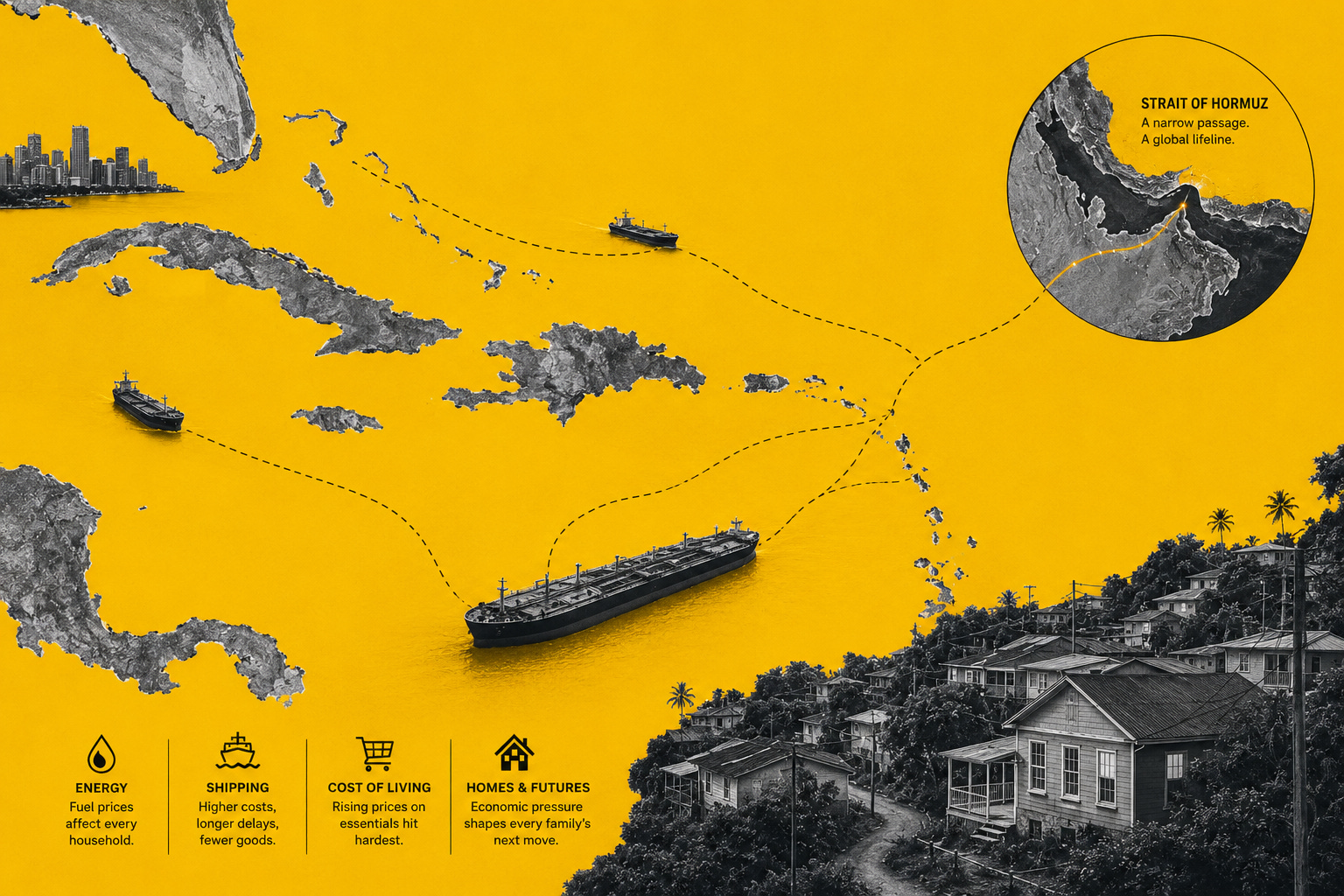
The Caribbean has always lived with the illusion of distance.
Wars happen “over there.” Oil crises begin “somewhere else.” Global supply chains collapse in places most Caribbean people will never see. Yet the modern Caribbean economy is built on imported fuel, imported food, imported materials, imported tourism confidence, imported shipping routes and imported financial stability. Which means the region is often one international crisis away from economic whiplash.
That reality is now colliding with the growing instability surrounding the Strait of Hormuz.
For most people in Jamaica, the Strait of Hormuz sounds remote, abstract, almost academic. But roughly one fifth of the world’s oil supply moves through that narrow passage between Iran and Oman. If disruption there becomes prolonged, the consequences will not stay in the Middle East. They will spread through shipping lanes, insurance markets, electricity generation, airline costs, tourism, construction pricing, food inflation and household survival itself.
And even if diplomacy succeeds tomorrow, the damage may already have begun.
Because economies do not simply “switch back on” after fear enters the system.
Confidence takes time to return.
Shipping contracts take time to stabilize.
Insurance premiums take time to fall.
Investors take time to trust again.
Fuel markets take time to normalize.
And small import dependent regions like the Caribbean often absorb the aftershocks long after headlines disappear from American television screens.
That is the danger Jamaica now faces.
The global economy runs heavily on perception. Once traders, banks, governments and corporations begin pricing instability into the future, everything becomes more expensive. Energy costs rise. Shipping costs rise. Borrowing costs rise. Construction costs rise. Food prices rise. Airfare rises. Business hesitation rises.
And Jamaica is unusually exposed to all of it.
The island imports most of what it consumes. Fuel powers transportation, electricity generation, tourism logistics and manufacturing. Many construction materials arrive through international shipping systems already weakened by years of pandemic disruption, geopolitical instability and inflationary pressure. The country’s tourism industry depends heavily on international air travel remaining affordable and psychologically safe.
War threatens all of those pillars simultaneously.
That is why the recent developments surrounding the Strait of Hormuz matter far beyond military strategy. Reports this week indicated that a proposed American operation to escort ships through the strait was paused after only one day amid attempts to secure a diplomatic framework with Iran. Discussions reportedly involve phased negotiations tied first to reopening and stabilizing the Strait of Hormuz before broader nuclear discussions.
The details may still shift by the hour. But the underlying message is unmistakable: the world is now dangerously close to a scenario where one maritime corridor could destabilize economies across continents.
In the Caribbean, that vulnerability feels especially acute because many governments entered 2026 already economically fragile.
Debt remains high across parts of the region.
Housing affordability remains under severe pressure.
Electricity costs are already among the highest in the Western Hemisphere.
Food insecurity continues affecting vulnerable populations.
And many Caribbean economies still depend heavily on tourism revenue that can evaporate quickly during periods of global uncertainty.
The Caribbean is not structured like the United States.
Americans often absorb economic shocks through scale. The U.S. has domestic energy production, massive internal markets and enormous fiscal flexibility. Caribbean economies do not possess those buffers. A sustained spike in oil prices or shipping costs can rapidly spill into daily survival.
In Jamaica specifically, the consequences could become deeply visible.
Electricity bills could climb further.
Public transportation costs could rise again.
Imported food prices could worsen inflation fatigue already affecting households.
Construction projects may slow as developers reassess costs and financing conditions.
Mortgage pressure could intensify if global interest rate uncertainty returns.
Tourism operators could face cancellations if travelers begin reducing discretionary spending amid global fear.
And perhaps most dangerously, consumer confidence itself could weaken.
That matters more than many policymakers admit.
Modern economies are psychological systems as much as financial systems. When populations become fearful about the future, spending slows. Investment slows. Hiring slows. Families postpone decisions. Businesses delay expansion. Real estate transactions stall. Developers pause projects. Banks tighten lending.
Fear itself becomes an economic force.
Jamaica has already experienced versions of this before.
During the pandemic, the island saw how quickly external shocks could threaten tourism, employment and household stability. Yet what is emerging now may prove more structurally dangerous because it intersects simultaneously with energy markets, global shipping, inflation psychology and geopolitical uncertainty.
And unlike Covid, there is no clear global emergency framework for this kind of disruption.
There is another uncomfortable reality the Caribbean must confront.
The world is entering an era where geopolitical instability may become semi permanent rather than temporary.
The assumption that globalization would steadily create peace now looks increasingly fragile. Conflicts are no longer isolated incidents. They are becoming recurring stress fractures inside an interconnected economic system already weakened by climate risks, debt burdens, migration pressures and political fragmentation.
Small island economies sit directly inside those fault lines.
Jamaica therefore faces a difficult strategic question:
How does a tourism dependent, import dependent island build resilience in a world becoming structurally less stable?
The answer cannot simply be “hope for peace.”
Hope is not an economic policy.
The region needs deeper conversations about energy independence, local food production, supply chain diversification, climate resilient infrastructure and financial self sufficiency. Jamaica has made progress in renewable energy development, but not nearly at the scale required for the instability now emerging globally.
The housing market reveals this vulnerability clearly.
Real estate across the Caribbean is increasingly tied to global capital flows, diaspora investment and tourism confidence. If prolonged geopolitical instability weakens international confidence or raises financing costs globally, the effects could ripple through property markets from Kingston to Montego Bay to Barbados to the Bahamas.
Already, many Caribbean households feel trapped between rising living costs and stagnant affordability.
A major global energy shock would intensify that pressure.
Construction materials would likely become more expensive.
Insurance costs could rise further in hurricane exposed regions.
Mortgage conditions could tighten.
Rent pressure could worsen.
And lower income families, already stretched thin by inflation, would absorb the harshest consequences first.
Yet paradoxically, crises also reshape wealth.
Periods of instability often redirect global capital toward locations perceived as politically stable, geographically attractive and strategically safe. Jamaica could potentially benefit from parts of that shift if diaspora investors, retirees and foreign buyers increasingly seek relatively stable Caribbean jurisdictions.
But that opportunity comes with its own danger.
If external capital accelerates while local affordability deteriorates, social inequality deepens. Entire housing markets can become disconnected from local earning power. We are already seeing early versions of this dynamic across parts of the Caribbean.
That is why this moment matters so profoundly.
The issue is not merely whether a war expands in the Gulf.
The issue is whether the modern global economic system has become too fragile for small vulnerable regions to depend on it in the same way they once did.
Even if diplomacy succeeds this month, markets have now seen how close the world came to severe disruption inside one of the planet’s most critical energy corridors. That memory alone may alter corporate behavior, investor calculations and government policy for months or years.
And if the situation worsens?
The consequences could become far more severe than many Caribbean governments are currently preparing for.
Fuel rationing discussions could re emerge globally.
Shipping delays could intensify.
Airline ticket prices could spike.
Food inflation could accelerate again.
Economic growth projections could weaken across multiple regions simultaneously.
Tourism dependent economies could face another major stress test.
For Jamaica, the challenge will not simply be surviving the immediate headlines.
It will be navigating the long psychological aftermath that follows them.
Because global crises do not end when ceasefires begin.
They end when markets trust again.
They end when shipping routes stabilize again.
They end when families stop fearing the next price increase.
They end when businesses stop delaying investment.
They end when ordinary people feel confident enough to plan for the future again.
And for many Caribbean nations, that recovery period may prove far longer than the war itself.