

Titles, Titles Everywhere
Jamaica’s New Korea Land Partnership Promises Modernisation, But Raises Questions About Sovereignty, Local Talent, and Long-Term Control


Kingston, Jamaica, 13 May 2026
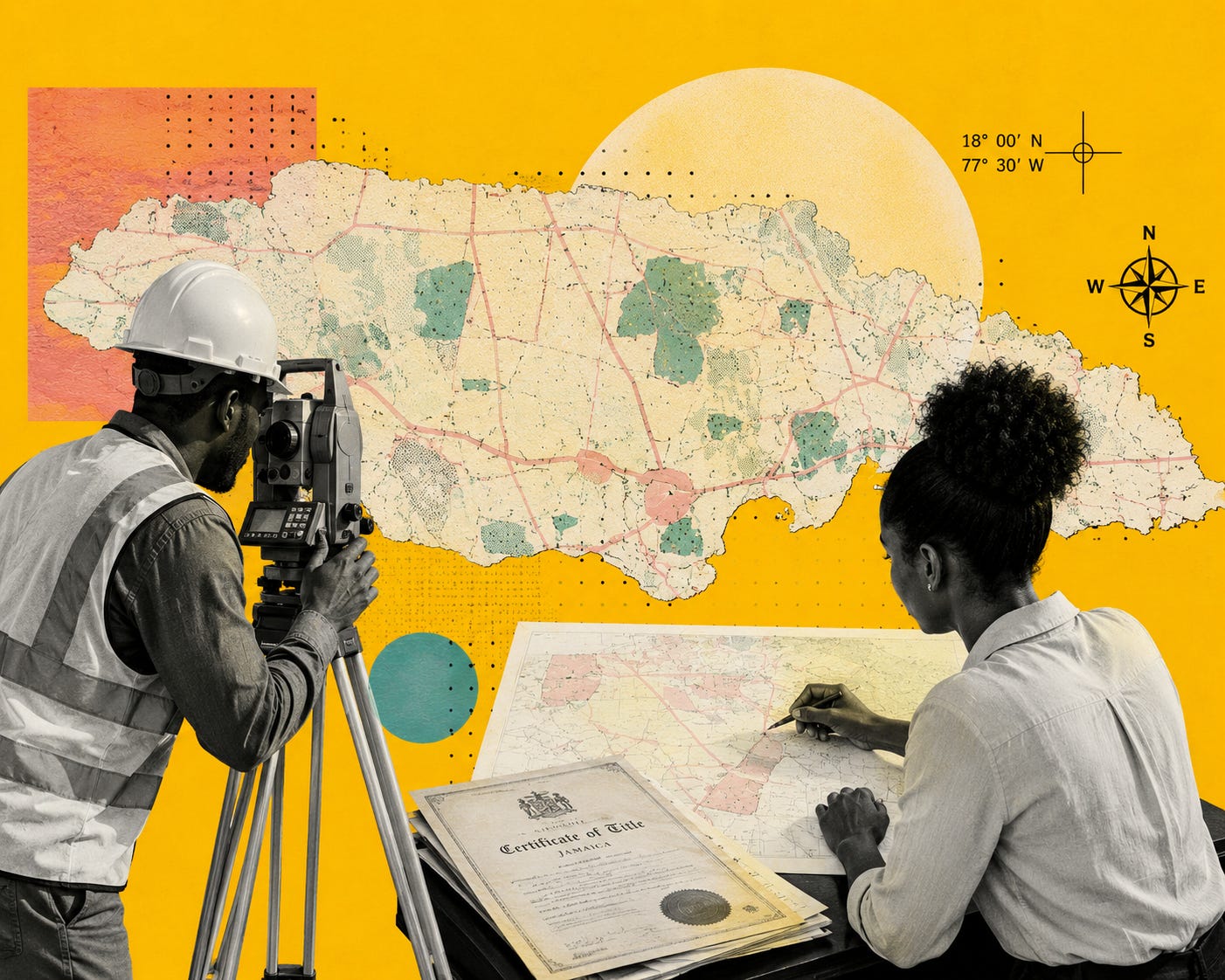
Jamaica’s latest land administration partnership with South Korea is being presented as a major step toward modernising the island’s ageing land titling system, but the announcement is also triggering deeper questions about sovereignty, local expertise, data control, and what future generations may inherit once the systems are fully built.
The approximately J$1.42-billion initiative, announced this week through a partnership involving the National Land Agency and the Korea International Cooperation Agency, aims to modernise cadastral mapping, digitise land records, improve geospatial systems, and accelerate land titling across Jamaica.
Government officials described the project as transformative, arguing that modern land administration is critical to housing, investment, development planning, and economic growth. The reforms are also tied to wider efforts to digitise Jamaica’s land infrastructure and reduce the large number of untitled properties across the island.
Supporters argue the programme could unlock opportunity for thousands of Jamaicans who occupy land informally or through longstanding family arrangements without legal titles. For many households, a formal title can mean access to mortgages, inheritance security, business financing, and protection against disputes.
Yet beneath the language of modernisation sits a more complicated national conversation, one increasingly familiar across developing countries navigating foreign-funded infrastructure and technology partnerships.
The central question is not whether Jamaica needs land reform. Few dispute that the country’s land systems require updating. The deeper issue is what Jamaica may gain, what it may lose, and whether modernisation strengthens national independence or gradually deepens reliance on foreign systems and expertise.
The Promise of Reform
Jamaica’s land administration problems are longstanding. Hundreds of thousands of parcels reportedly remain outside the formal registration system, creating difficulties for inheritance, development approvals, financing, taxation, and planning.
The Government argues that modern digital systems could significantly reduce delays and improve transparency while helping families secure legal ownership.
The partnership with Korea is expected to bring technical support, surveying systems, digital infrastructure, geospatial expertise, and specialised training. Korea itself is internationally recognised for advanced cadastral and digital governance systems, having transformed much of its own administrative infrastructure over the past several decades.
Officials say Jamaica’s reforms are intended to support housing growth, improve planning capacity, and help bring more citizens into the formal economy.
For a country facing increasing housing pressure, rapid urban expansion, climate vulnerability, and generational uncertainty around ownership, the reforms could eventually reshape how land is managed and transferred for decades to come.
The Best Outcome
At its most optimistic, the Korea partnership could become a turning point in Jamaica’s development.
If successful, Jamaica could emerge with a far more efficient land administration system, faster title processing, stronger planning capacity, and better protection for families occupying land informally for generations.
The ideal outcome would not simply involve imported systems, but genuine knowledge transfer.
That could mean Jamaican universities expanding geospatial and land management programmes, local surveyors and software professionals gaining world-class expertise, and a new generation of Jamaican technical specialists eventually managing and improving the systems independently.
In that scenario, the project becomes less about foreign assistance and more about national capacity building.
It could also improve disaster resilience, planning accuracy, infrastructure development, agricultural investment, and housing expansion at a time when land security is becoming increasingly tied to climate adaptation and economic stability.
The Worst Outcome
Critics and observers, however, warn that large-scale foreign-backed modernisation projects can sometimes create quieter forms of dependency.
The concern is not that Jamaica is surrendering legal ownership of land. There is no evidence the agreement transfers sovereignty over Jamaican territory.
The fear is more subtle.
Modern land systems increasingly rely on digital infrastructure, proprietary software, data architecture, cloud systems, licensing agreements, and specialised maintenance. If those systems become too externally dependent, future governments may find themselves operating infrastructure they do not fully control intellectually or technologically.
Questions are already emerging around data sovereignty, local ownership of expertise, and whether Jamaica’s own technical community is being sufficiently prioritised.
Some professionals worry that Jamaican surveyors, GIS specialists, planners, engineers, and software developers could end up supporting foreign-led systems rather than leading the transformation themselves.
Others fear that local innovation may struggle to compete if prestige contracts, systems architecture, and technical leadership remain largely external.
There are also broader social concerns.
Formal land titling can bring opportunity, but it can also expose vulnerable families to market pressures. Once land becomes fully formalised, it may become easier to tax, mortgage, transfer, or ultimately lose through debt or speculative pressure.
Family land systems, though often legally complicated, have historically acted as informal safety nets for many Jamaicans. Critics argue that rapid formalisation without strong protections could gradually weaken some of those traditional buffers.
A Wider Global Debate
Jamaica is not alone in confronting these questions.
Across the developing world, countries are increasingly balancing the benefits of foreign investment and technical partnerships against concerns about long-term control, local industry development, and national independence in the digital age.
Modern sovereignty is no longer measured only by flags, borders, or military control. Increasingly, it is tied to who owns the systems, the data, the technical knowledge, and the infrastructure underpinning national life.
Land administration sits at the centre of that reality because land is more than property. It is inheritance, wealth, security, identity, and future development.
The issue therefore extends beyond bureaucracy. It touches housing, family stability, economic mobility, and the long-term structure of Jamaica itself.
What Happens Next
Much will depend on how deeply local institutions are integrated into the project over time.
If Jamaican professionals are genuinely trained, empowered, and placed at the centre of the modernisation effort, the partnership could strengthen national capability for generations.
If not, critics fear the country could emerge with modern systems but limited long-term independence over the technology, expertise, and economic value surrounding them.
For now, the Korea partnership represents both opportunity and caution, a reminder that development is rarely only about what a country builds, but also about who ultimately controls the tools used to build it.