


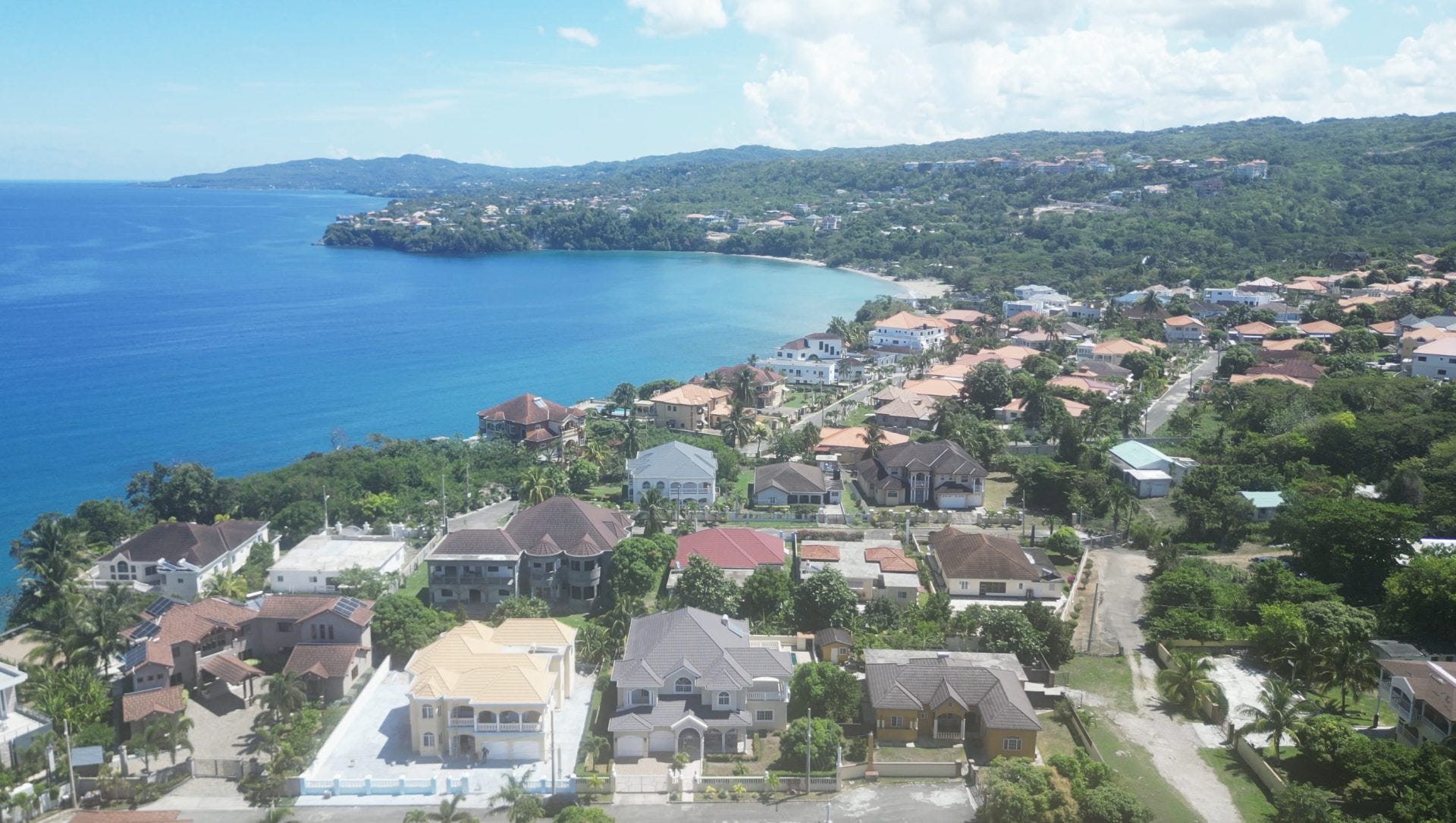
Stand on the coral edge at Tower Isle and you feel the breeze arrive before you hear it. It comes off the water cool and courteous, slipping through almond trees and across low white walls. This is not a coastline that shouts. It edits. Over time, it has trimmed away excess and left a considered sequence of experiences: a slim cove, a limestone outcrop, a path that knows when to turn its gaze inland. If Jamaica has a north-coast whisper rather than a roar, this is it.
Tower Isle’s latest chapter isn’t about spectacle. It’s about calibration—the kind of modernism that understands the island’s temperament and answers it with measured lines, careful materials, and buildings that refuse to fight the climate. There’s steel here, yes, and glass by the square metre, but the ambition isn’t to defy sun and salt. It’s to befriend them.
You notice it in the proportions first. Roofs that project just far enough to throw afternoon shade. Verandas that measure width not by prestige but by the arc of a chair turned toward the sea. Doorways tall enough for a cooling stack effect, yet modest enough to make a room feel like a refuge. Thoughtful design is often a story of subtracting a centimetre here, adding a sliver there, until the building breathes in cadence with the day.
Amid this careful re-tuning of Tower Isle, a boutique development has surfaced with a rather telling name: Vista Deluxe. The moniker risks bravado, but the architecture—if it holds course—leans toward discretion. It’s small-batch, as many of the better projects here are. A handful of homes, not a forest of them. The promise is not a daily parade of amenities; it’s a guarantee of sightlines and breeze paths. That’s the correct emphasis in a place where luxury is measured by how little you need to turn on the air-conditioning.
Walk the site and you begin to see the grammar: deep overhangs, louvred vents, timber accents that will silver, not sulk, under salt. If the detailing is done with the right humility—marine-grade fixings, sacrificial layers where the spray hits hardest—the buildings will age into the setting, not just sit in it. We too often celebrate a finish on day one and forget that day one is the worst it will ever look. Sensible coastal architecture designs for patina.
What’s striking about Tower Isle now is how its modernism has learned restraint. The coastline has seen the phase of the big gesture—the mega-hotel, the oversized pool with opinions. Today’s better moves here are scaled for human rhythms: a 6 a.m. swim before the sun gets teeth, a lunchtime nap under a ceiling fan, a 10-minute drive to Ocho Rios that still somehow feels like leaving the world.
Real estate, of course, is never just about walls. It’s a choreography of logistics—airports, provisioning, trades—and on that count Tower Isle is agile. Ian Fleming International is a short hop away, neatly collapsing travel time for owners who want the island without the odyssey. The proximity to Ochi supplies restaurants and errands; the return to Tower Isle restores the pulse. This is the old trick of the perfect neighborhood: be near everything, feel close to nothing.
Yet there’s a responsibility that sits alongside convenience. Modern heaven is fragile precisely because it’s desirable. Scale it incorrectly and the intimacy evaporates. Build with vanity materials and you sentence owners to a lifetime of repairs. Ignore the trades and you design details no carpenter can actually make. Sensible paradise is an exercise in constraint.
Dean Jones, founder of Jamaica Homes, puts it this way: “True luxury is a building that disappears into your day. You don’t notice the door heights or the soffit depth; you notice that you slept well and the room stayed cool without effort.”
He’s right. The best design solutions are unshowy. Consider the humble breezeblock—a Jamaican classic that filters air and softens light. In the wrong hands it’s kitsch. In the right hands, patterned screens give privacy to a terrace and make the shadows move like theatre. Or take water: a small plunge pool set into limestone, shaded by a frangipani, is a better companion than a giant, sun-struck rectangle that boils at noon.
Vista Deluxe, if it’s to merit its name, should be judged as much by the boring drawings as the glossy ones—the sections that prove cross-ventilation, the details that show how window heads keep rain from flirting with interior plaster, the drainage that acknowledges a tropical downpour doesn’t file for planning permission. On the coast, competence is charisma.
What does this mean for the people who will live here? It means mornings with coffee and the line where sea meets sky. It means that walking barefoot between kitchen and terrace is a daily ritual, not a holiday indulgence. It means storage that swallows paddle boards and the less Instagrammable paraphernalia of a life lived outdoors. And it means that when a storm advances from the horizon, the buildings are more than a view—they’re a shelter with a strategy.
Jones again: “Homes at the ocean are contracts with the elements. The ones that endure are written in the language of the breeze.”
There’s a cultural point too. The north coast has always carried a certain performance—the soundtrack of arrival, the cameo of the islet offshore—but Tower Isle’s current mood is different. It’s a longer note, more baritone than brass. Owners here tend to be the keep-it-tidy tribe: fewer statements, more stewardship. The gardens are native, the outdoor showers are honest, the lighting respects the night. None of this makes for spectacular brochures. All of it makes for a better place to live.
Markets notice this tone. Properties that practice restraint often have a second, quieter market at resale: buyers who are tired of battling maintenance and seek an architecture that does the work for them. The value doesn’t shout; it holds. It is, to borrow a phrase from the craft world, “fit for purpose.”
Still, we should resist utopia talk. Construction, anywhere, is a negotiation with reality. Timelines flex, shipments delay, the perfect tile reveals its imperfections under tropical shadow. What separates good projects from great ones is not the absence of complications but the presence of judgment. Where do you allow for movement? Which detail gets the budget? What can the local craft economy competently deliver—and with pride? Vista Deluxe will live or die by those answers.
Jones offers a final provocation: “Property is often sold as an escape, but the best homes don’t let you escape at all—they return you to yourself.”
Perhaps that’s Tower Isle’s real transformation. Not into a theme-park modernism, but into a mature ecosystem for island living—one that stitches together climate-literate buildings, merciful travel times, and a day shaped more by trade winds than by thermostats. If the area keeps favouring small over sprawling, longevity over novelty, then the phrase “modern haven” won’t be marketing copy. It will be a simple description of how it feels to open a louvred window, hear the gulls working the morning water, and sense that the house, the weather, and your breath are all keeping time.
And if Vista Deluxe becomes part of that cadence—if it chooses thoughtfulness over drama—then it will add one more quiet measure to a coastline that’s learning, at last, to sing softly and endure.
Editor’s notes & sources: Historical and brand information on Tower Isle’s origins and Couples Resorts; proximity and transfer details for Ian Fleming International Airport (OCJ); drive-time and distance estimates to Ocho Rios; current and recent real-estate activity and listings indicative of market texture; observer reporting on demand dynamics and parish-level investment.
This article was reported from St Mary on October 14, 2025.Disclosure: “Vista Deluxe” is marketed by Dean Jones of Jamaica Homes.
Disclosure: “Vista Deluxe” is marketed by Dean Jones of Jamaica Homes.