

Two Jamaicas Are Emerging Inside One Housing Market
As tourism, climate pressure, rising costs, and global instability reshape Jamaica, many ordinary Jamaicans are being priced out of the country still being sold to the world.

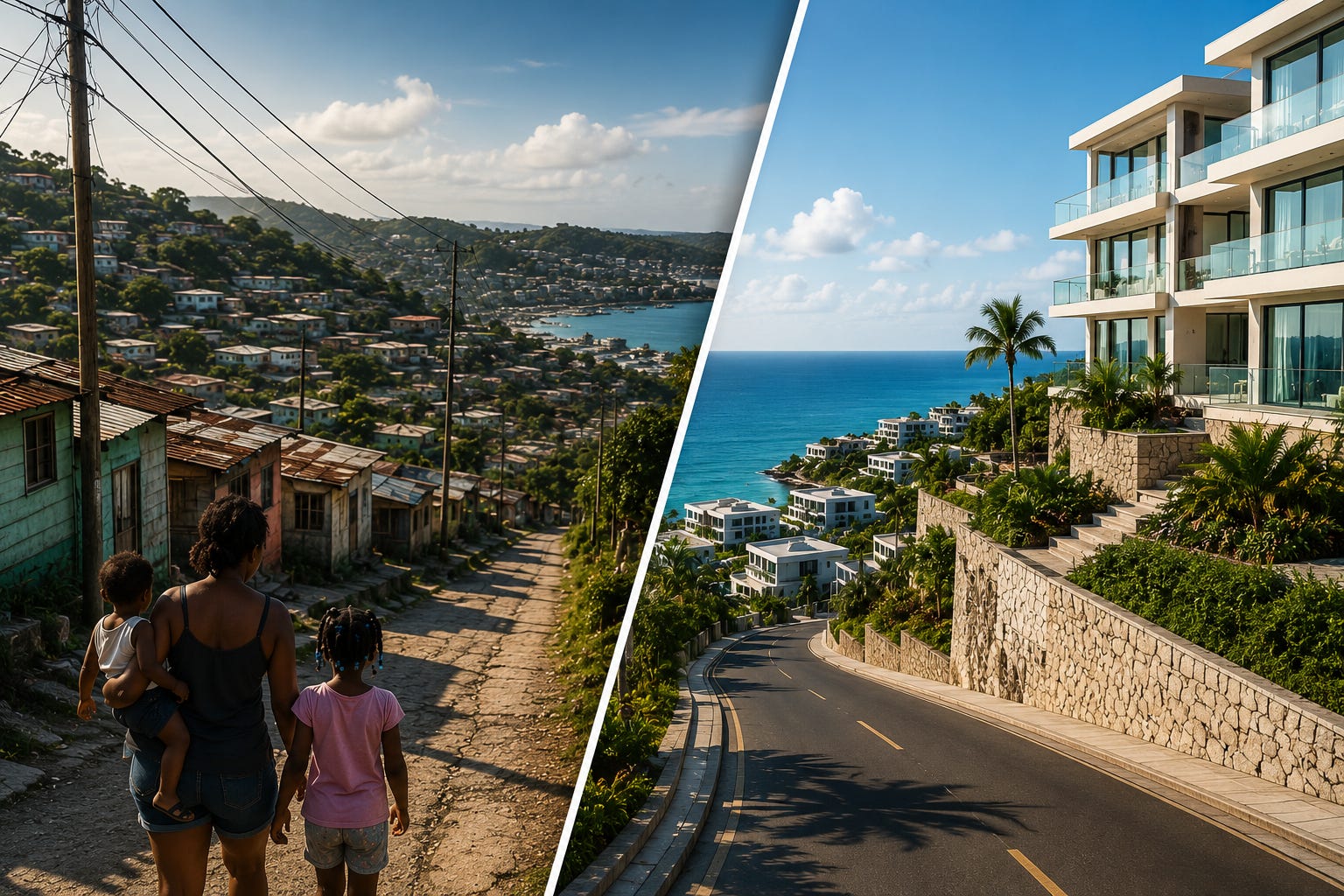
Jamaica’s economy grew through tourism, remittances, and construction, but many households still struggle to afford land, rent, or mortgages\Property prices in parts of Kingston, Montego Bay, and the north coast increasingly reflect international demand rather than local wages
Climate risks and rising insurance costs are quietly becoming major factors in housing affordability and investment decisions
Construction inflation continues to push up the cost of building materials, labour, and financing across the island
Jamaica’s housing conversation is no longer only about supply. It is increasingly about who the market is actually being built for
There was a time when the Jamaican dream felt difficult but still visible. A modest house. A small piece of land. A route upward through work, sacrifice, remittances, and patience. For generations, families built homes room by room, barrel by barrel, block by block. Ownership was not easy, but it still felt possible.
Today, for many Jamaicans, that feeling is beginning to shift.
Across sections of Kingston and St Andrew, average home prices have climbed into ranges that many middle income earners cannot realistically finance. In resort areas and tourism corridors, properties are increasingly marketed in U.S. dollars, even while the majority of Jamaican salaries remain paid in Jamaican currency. Construction costs continue to rise. Mortgage rates remain relatively high compared with major economies. Insurance premiums are becoming more expensive. Rent continues to pressure household income. Meanwhile, wages have not risen at the same pace as housing costs.
The result is a growing sense that two Jamaicas are beginning to emerge within the same property market.
One Jamaica is connected to tourism, foreign investment, global capital, remittances, short term rentals, returning residents, and upper income development. The other Jamaica is trying to survive rising living costs while struggling to access stable housing, affordable mortgages, or even secure rental arrangements.
The divide is becoming harder to ignore.
“A country reaches a dangerous point when the people serving the economy can no longer afford to live inside the economy they are helping to build.”
— Dean Jones, Founder of Jamaica Homes
The Tourism Economy and the Property Economy Are Becoming Increasingly Connected
Tourism remains one of Jamaica’s largest economic drivers. The sector contributes billions of U.S. dollars annually and supports thousands of jobs directly and indirectly. New hotels continue to rise along the north coast. Luxury villas and resort communities continue to expand. International marketing campaigns continue to present Jamaica as one of the Caribbean’s premier investment and lifestyle destinations.
But tourism success has also created pressure inside the housing market itself.
Properties in areas connected to tourism often begin reflecting international purchasing power rather than local earning power. A one bedroom apartment in parts of Kingston can now command monthly rents that rival mortgage payments in some overseas markets. In sections of Montego Bay and Ocho Rios, short term rental demand has altered the economics of long term housing supply. Land values in tourism corridors have increased sharply over the last decade.
For investors, these shifts may represent opportunity.
For many ordinary Jamaicans, they increasingly represent exclusion.
The issue is not unique to Jamaica. Cities from Lisbon to Barcelona to parts of Mexico have seen local residents raise concerns about tourism driven housing inflation. But in Jamaica, the pressure is amplified by lower average wages and long standing structural inequality.
According to the Statistical Institute of Jamaica, average earnings still remain far below the levels required to comfortably finance many modern urban housing developments. At the same time, imported construction materials, financing costs, and infrastructure expenses continue to rise.
The mathematics simply do not work for many households.
The Cost of Building Has Quietly Changed Everything
For years, Jamaicans have adapted to rising costs through creativity and resilience. Families built incrementally. Relatives abroad sent remittances. Skilled tradesmen worked across extended family networks. Communities often relied on informal systems to expand housing stock over time.
But modern construction economics are becoming harder to absorb.
The cost of cement, steel, roofing materials, electrical components, plumbing fixtures, imported finishes, and freight has increased significantly since the pandemic period. Global supply chain disruption, geopolitical instability, shipping volatility, and currency fluctuations continue to affect pricing.
Even small changes in exchange rates can have major effects in Jamaica because so much of the construction sector remains import dependent.
When the Jamaican dollar weakens against the U.S. dollar, construction costs often rise almost immediately. Developers pass costs to buyers. Contractors adjust quotations. Landlords increase rents. Insurance valuations rise. Mortgage requirements become harder to satisfy.
What begins as a global economic issue eventually arrives at the gate of the ordinary Jamaican household.
A generation ago, some families could realistically hope to build over time while living on the same property. Today, in many urban areas, even acquiring the land itself has become one of the largest barriers.
Climate Risk Is Becoming a Housing Story
For decades, climate change was often discussed as an environmental issue. Increasingly, it is becoming a housing issue.
Coastal erosion, flooding, hillside instability, stronger storms, drainage failures, and infrastructure vulnerability all carry financial consequences for property owners. In some communities, insurance premiums are rising quietly in the background while many homeowners remain underinsured or uninsured altogether.
Industry estimates have long suggested that a large percentage of Jamaican homes either lack insurance entirely or remain significantly underinsured relative to reconstruction costs.
That creates a dangerous gap between perceived wealth and actual protection.
A house may appear valuable on paper, but if it cannot be properly rebuilt after disaster, its financial security becomes uncertain.
This issue becomes even more serious when combined with informal construction practices, unapproved additions, ageing infrastructure, or limited emergency savings.
At the same time, climate pressure also influences future development patterns. Areas once considered highly desirable may eventually face increased insurance scrutiny or rising infrastructure costs. Communities vulnerable to flooding or erosion may become more expensive to protect over time.
The long term implications could reshape not only where Jamaicans invest, but where Jamaicans can realistically afford to live.
“Jamaica’s housing crisis is no longer just about homes. It is becoming a question of whether ordinary Jamaicans will still have a meaningful stake in the future value of their own country.”
— Dean Jones, Founder of Jamaica Homes
The Rise of the U.S. Dollar Housing Market
One of the most emotionally charged issues in Jamaica’s housing discussion remains the growing visibility of U.S. dollar pricing.
Luxury homes, apartments, villas, and even some rentals are increasingly advertised in foreign currency. Defenders argue this reflects construction realities, imported materials, and international investment demand. Critics argue it disconnects housing from local economic reality.
The concern goes beyond currency itself.
For many Jamaicans, U.S. dollar pricing symbolises a wider fear that sections of the island are gradually becoming economically inaccessible to the very people who live there.
This does not mean foreign investment is inherently negative. Jamaica benefits significantly from overseas capital, returning residents, tourism development, and diaspora investment. Many developments create employment, improve infrastructure, and stimulate surrounding economies.
But difficult questions are beginning to emerge alongside the growth.
Who is the modern Jamaican housing market truly being designed for?
Can a country sustain long term social stability if increasing numbers of young professionals, skilled workers, and middle income families feel permanently locked out of ownership?
What happens when teachers, nurses, police officers, social workers, hospitality staff, and young entrepreneurs increasingly struggle to buy within the communities they serve?
These are not anti investment questions.
They are national sustainability questions.
Jamaica’s Traditional Housing Model May Become Important Again
Ironically, while many Western countries now discuss “multi generational living” as a new economic adaptation, Jamaica has long practised versions of it out of necessity.
Family land. Shared yards. Added rooms. Upstairs expansions. Backyard cottages. Informal annexes. Extended family compounds.
What some societies are only now rediscovering, Jamaicans have quietly navigated for generations.
As affordability pressures intensify globally, these traditional Jamaican housing structures may increasingly be viewed not as backward systems, but as resilient survival models shaped by economic reality.
Still, resilience should not become an excuse for complacency.
The fact that Jamaicans are adaptable does not remove the importance of affordable housing policy, responsible urban planning, infrastructure investment, mortgage accessibility, and wage growth.
A population surviving is not necessarily the same as a population thriving.
The Housing Conversation Is Becoming Bigger Than Housing
At its core, this is no longer simply a conversation about real estate.
It is a conversation about national identity, economic direction, social stability, class mobility, migration, and the future shape of Jamaican society itself.
Housing sits at the centre of almost every major pressure facing modern Jamaica. Inflation. Crime. climate vulnerability. Tourism dependence. Brain drain. Wage pressure. Infrastructure strain. Family formation. Migration. Insurance. Currency instability.
The market reflects all of it.
For some, Jamaica remains a paradise investment story filled with opportunity, expansion, and growth.
For others, it increasingly feels like a country becoming harder to afford while they are still living inside it.
Both realities can exist at the same time.
And perhaps that is the uncomfortable truth Jamaica now faces.
The island is not simply experiencing a housing boom.
It may be experiencing the slow emergence of two very different Jamaicas living inside the same economy.