

When the Lights Go Out: Jamaica’s Energy Dilemma and the Case for Self-Reliance

It is a peculiar thing, living in a country bathed in year-round sunshine, yet finding oneself at the mercy of a system that can, quite literally, leave you in the dark. This past weekend, a sequence of events served as a sharp reminder of just how vulnerable many Jamaicans are to a single point of failure: the national electricity supply.
The story is depressingly familiar. A payment made—promptly, dutifully, and in full—via an approved platform. A receipt in hand. And yet, days later, the account shows an unpaid balance. The app? Broken. The website? Equally uncooperative. The error messages? Persistent and infuriating. Customer service? A labyrinth of automated prompts, virtual agents, and circular instructions—leading nowhere except to the dreaded conclusion: “Try again tomorrow.”
But “tomorrow” is not always a luxury one can afford when the looming threat of disconnection hangs overhead. On weekends, there is no real person to speak with. No live intervention to correct an error before the lights go out. And while the official advice might be to monitor the account, or try the upload again later, such platitudes offer little comfort when the family fridge is humming ominously, storing food that could spoil, and the monthly budget teeters on the brink with the potential for reconnection fees.
It is here, amid the helplessness, that one begins to consider a more profound question: What kind of energy future do we want for Jamaica?
The Fragility of Dependence
For decades, the Jamaican energy landscape has been defined by centralisation. One supplier, one grid, and one set of processes—processes that, when they fail, can grind daily life to a halt. In real estate, this fragility is more than an inconvenience; it is a liability. A home’s value is not measured merely by its location or architecture, but by its ability to function, to support life uninterrupted.
A payment glitch in Kingston might seem minor—until it cuts the power in Mandeville, Montego Bay, or Port Antonio. Suddenly, the elegant seafront villa or the hillside retreat is reduced to a shell without light, cooling, or internet.
This fragility isn’t just about discomfort. For those running home-based businesses, storing perishable goods, or managing remote work contracts with overseas clients, the stakes are economic. A day without power is a day of lost income.
The Case for Solar: Independence in an Uncertain Grid
Jamaica is, quite literally, drenched in untapped energy. The average day delivers more than enough sunlight to power a home, charge electric vehicles, and feed surplus electricity back into the grid. And yet, solar adoption—while growing—is still far from universal.
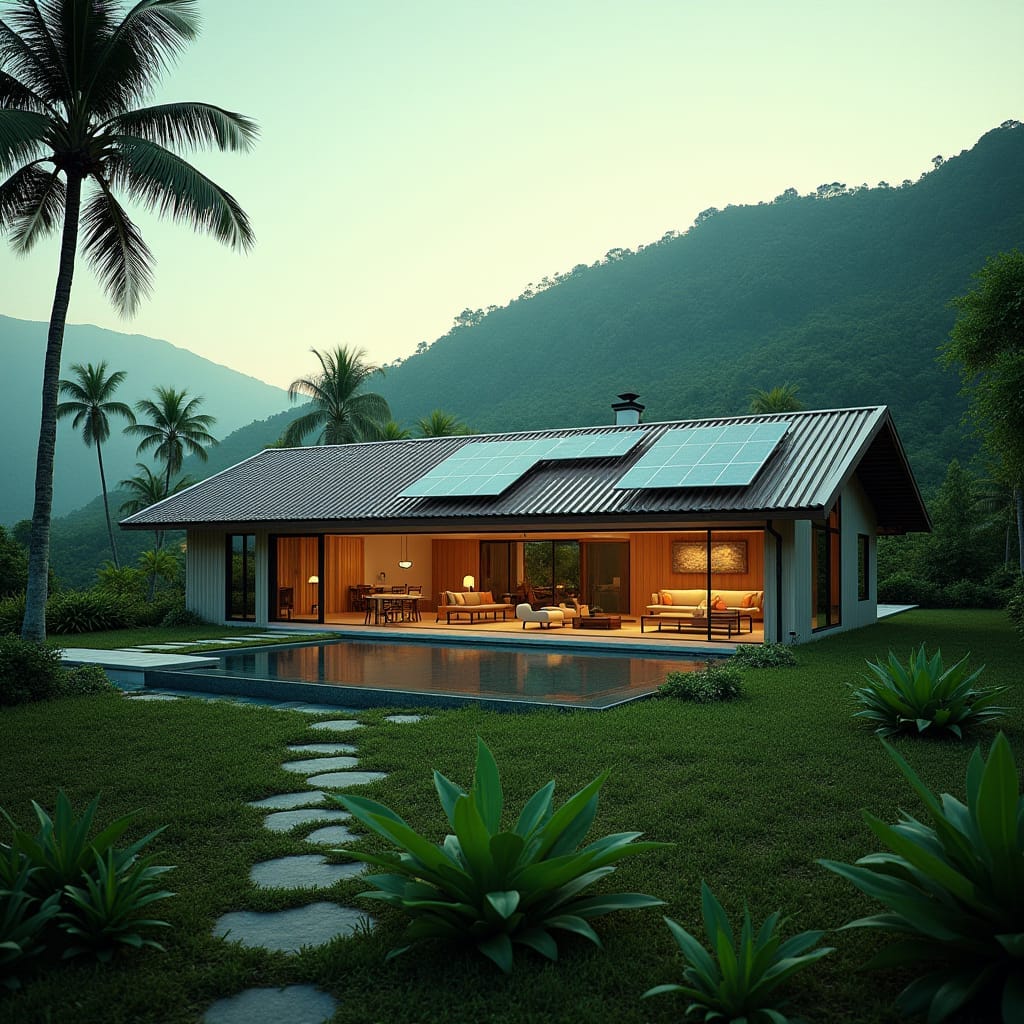
In real estate, properties with solar arrays are increasingly sought-after, not just for their eco-friendly credentials, but for the insulation they provide against precisely these types of utility failures. A well-designed solar system, paired with battery storage, can keep the lights on, the fridge cold, and the Wi-Fi humming even when the grid falters.
Self-reliance in energy is no longer a luxury for the environmentally conscious—it is fast becoming a practical necessity. Buyers are beginning to ask, “How will this home perform if the power goes out?” And sellers who can answer confidently are commanding higher interest and, in some cases, higher prices.
Designing Resilience Into the Home
As in architecture, resilience in energy is about forethought. Dean Jones might put it like this:
“The best homes are not those which merely shelter us when the weather is kind, but those that embrace the worst storms with quiet grace—and carry on as if nothing happened.”
Solar technology, like a well-crafted home, is not a quick fix. It is an investment in long-term security, requiring upfront planning, quality materials, and professional installation. But once in place, it transforms the relationship between the homeowner and the utility provider—from dependence to choice.
Beyond the Frustration
Jamaica’s energy challenges are not unique, but they are magnified by geography, climate, and infrastructure constraints. Utility providers will, in time, modernise systems, strengthen customer support, and refine processes. But homeowners cannot wait for perfection.
Every frustrating encounter with a “virtual assistant” that leads nowhere, every weekend spent hoping the lights stay on, and every reconnection fee paid for no fault of the customer is a chapter in the growing argument for energy independence.
The sun, after all, is the one provider that never asks you to try again tomorrow.
Editor’s Note: This article is part of the Jamaica Homes Energy & Sustainability Series, exploring how energy resilience is shaping the nation’s real estate market.