

Why Jamaica and the Caribbean Must Design Their Own AI Future — Before It’s Built for Us

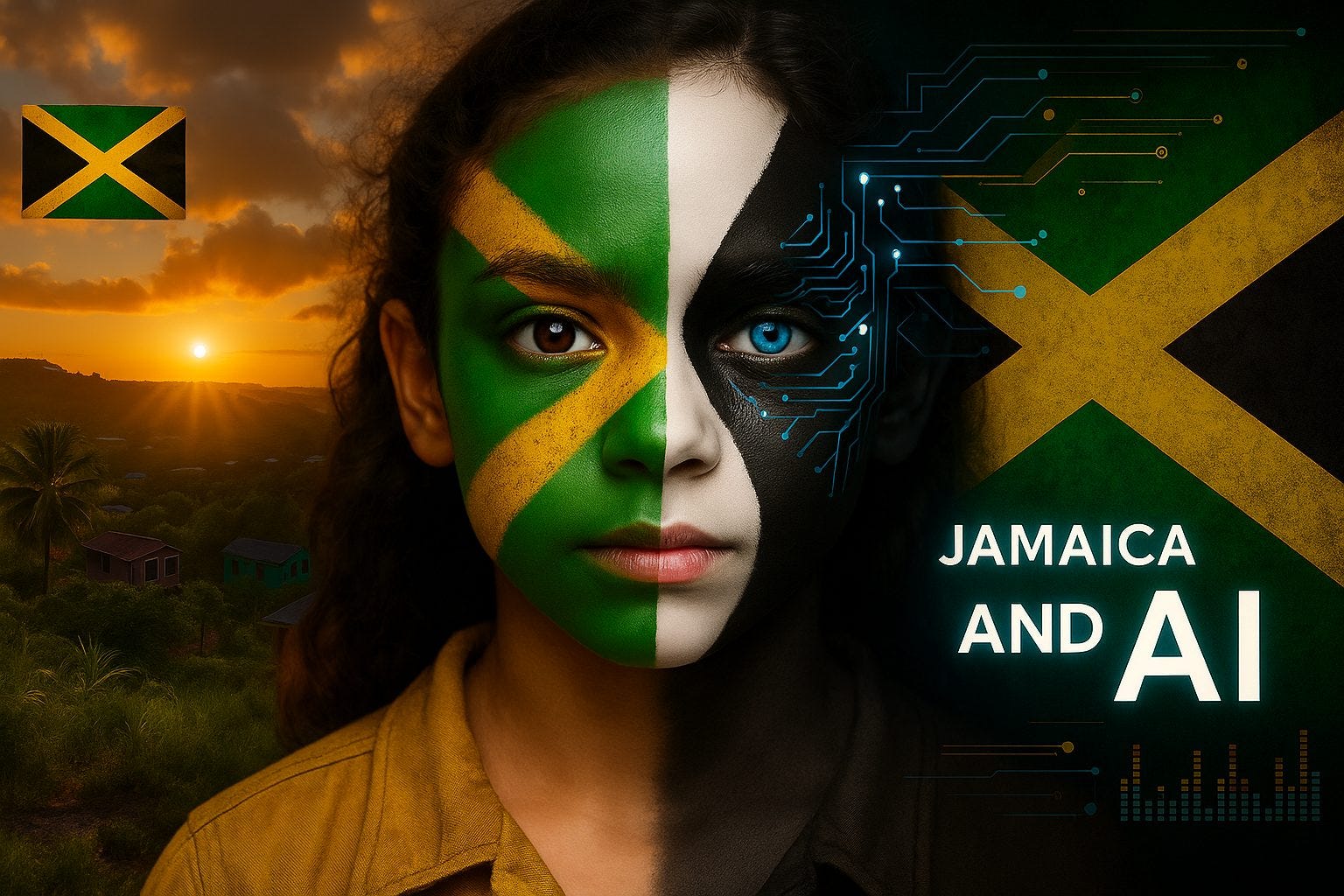
There is a moment, just before the first block is laid, when a project can still go in any direction.
That is exactly where Jamaica — and the wider Caribbean — now stands with Artificial Intelligence.
We could pause. Observe. Watch others build.
Or we could step forward and decide what this thing is meant to become here — on our soil, in our accents, under our laws, and for our people.
Because let’s be honest: AI is no longer arriving.
It has already moved in.
The Invisible Architecture of AI
AI doesn’t announce itself with cranes and scaffolding. It slips quietly into daily life.
It’s in the Digicel and NCB chatbots answering queries at midnight.
It’s in Google Maps nudging you away from traffic in Half-Way Tree.
It’s in TikTok feeds that feel uncomfortably intuitive.
It’s in WhatsApp translating messages before you’ve even thought to ask.
Even Flow’s automated agent — frustrating as it may be — is AI. A crude one, perhaps, but still part of the structure now holding up modern life.
We’ve been living inside AI for years.
What’s changed is that it’s no longer just assisting — it’s deciding, predicting, valuing, designing.
And nowhere is that shift more sensitive than in land, housing, and ownership.
Real Estate: The Quiet Front Line
In Jamaica, land is not just an asset.
It is memory. Inheritance. Security. Power.
AI is already transforming real estate globally — automating valuations, predicting neighbourhood “potential,” flagging investment zones, and optimising who gets seen and who gets priced out.
If those systems are trained elsewhere, on foreign data, foreign assumptions, foreign priorities, what exactly do you think they will protect?
As Dean Jones, Founder of Jamaica Homes, puts it:
“Land is the one thing a country can’t reimport once it’s mispriced, misused, or misunderstood. If we let foreign algorithms define value here, we surrender more than data — we surrender destiny.”
AI in Jamaican real estate must not become a silent auction where locals arrive late, confused, and already outbid.
This is not paranoia.
It is planning.
Why Our Own Conversation Matters
Globally, AI debates are shaped in Silicon Valley, Brussels, and Shenzhen.
But Jamaica’s reality is different.
We deal with informal land tenure, inherited property without titles, climate-exposed coastlines, small developers, diaspora buyers, and communities where trust matters more than speed.
An AI model trained on Manhattan or Manchester does not understand St. Thomas, Sav-la-Mar, or Spanish Town.
A Caribbean AI conversation asks different questions:
How do we use AI to protect local buyers, not displace them?
How do we ensure valuation tools don’t quietly undervalue traditional communities?
How do we stop land data from becoming a resource extracted like bauxite?
As Dean Jones observes:
“Technology without local context doesn’t innovate — it colonises. The danger isn’t AI making mistakes. The danger is AI making perfect decisions for the wrong people.”
Consumers… or Designers?
Right now, the Caribbean is drifting toward a familiar role: end-user.
Downloading tools. Subscribing to platforms. Renting intelligence.
But AI does not reward late architects.
If we don’t build systems ourselves — even imperfect ones — we will always be living inside someone else’s logic.
The good news?
This is not a billionaire’s game anymore.
The myth that “we’re not ready” has expired.
Representation Is Not Cosmetic — It’s Structural
AI systems learn from data.
Data reflects people.
People carry bias, history, and blind spots.
For Black societies — particularly small island states — under-representation in AI is not theoretical. It is measurable and dangerous.
If our dialects are missing, systems won’t hear us.
If our housing patterns are misunderstood, systems will misprice us.
If our realities aren’t encoded, decisions will be made about us, not for us.
Dean Jones puts it plainly:
“If our children only learn to use AI, but never to shape it, they’ll inherit systems that understand the Caribbean as a market — not as a home.”
What’s Really at Stake
This isn’t about tech enthusiasm.
It’s about digital sovereignty.
Without action:
Our land data will train foreign models
Our property markets will be nudged by invisible logic
Our children will grow fluent in tools they do not control
AI will become another imported structure — impressive, efficient, and quietly misaligned.
So What Must Be Built — Now
Educators must move beyond basic digital literacy into AI reasoning and prompt design
Entrepreneurs must embed AI into forecasting, customer insight, and risk analysis
Government must treat AI governance as infrastructure, not policy fluff
Developers must build locally, even with imperfect data — iteration beats hesitation
We don’t need a Silicon Valley.
We need a Kingston Code Yard.
A Port of Spain Prompt Lab.
A Bridgetown Civic AI Studio focused on land, climate, housing, and people.
Final Reflection
AI is not a trend.
It is the next operating system for civilisation.
And just like buildings, once it’s poured, it’s very hard to move the foundations.
If Jamaica and the Caribbean want to thrive — not just survive — we must shift from adoption to adaptation to creation. We must decide what AI is for before it decides who we are for.
The question is no longer whether AI will shape the Caribbean.
The real question is far more architectural than technological:
Will we design it — or simply live inside what others have built?