


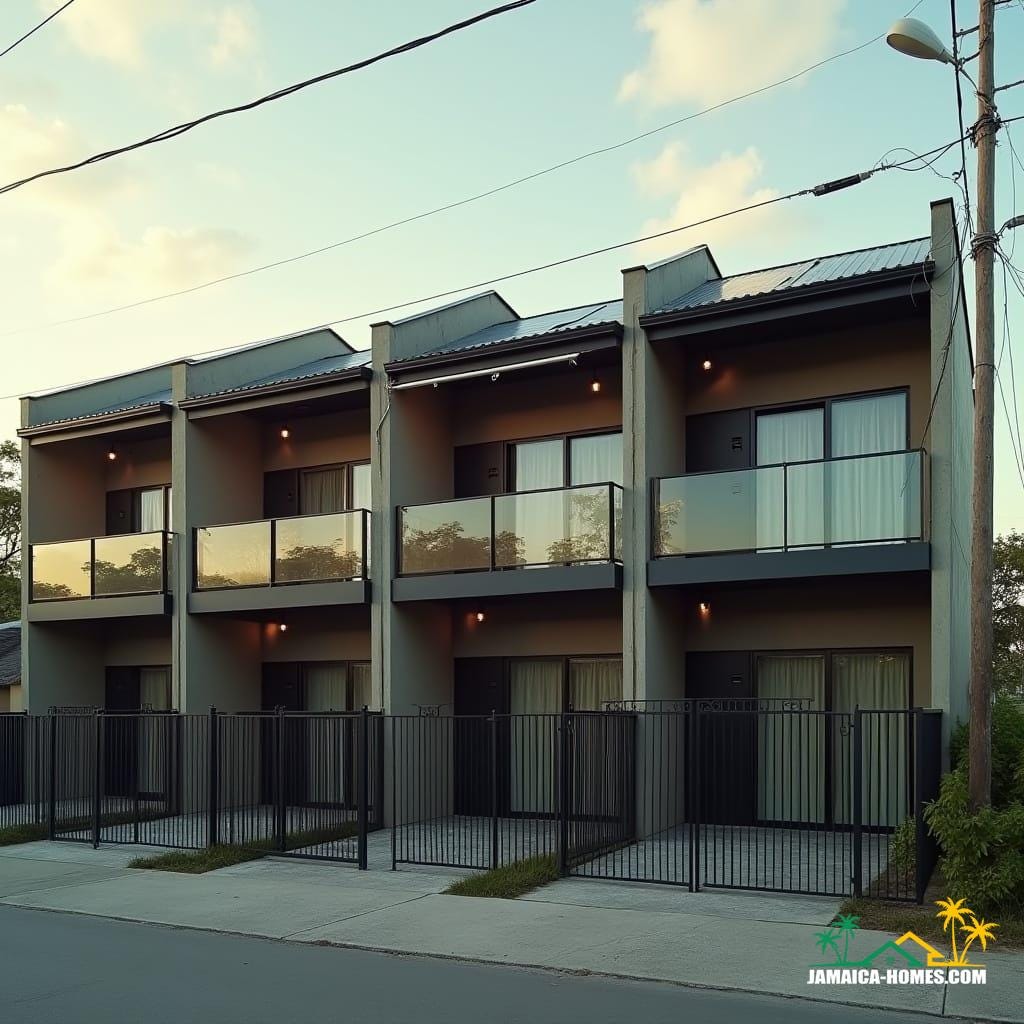
For years, the Jamaican dream of owning a home has been wrapped up in a very specific image: a detached house, a fence, a gate, and just enough yard to say “mi reach.” That image still matters. But the housing conversation on the island is evolving, and not because people suddenly want less, but because they want something that actually works.
Across Jamaica, more buyers—especially first-time buyers, young professionals, returnees, and practical investors—are starting to look differently at what “owning a home” really means. The question is no longer “Can I get the biggest house?” but rather “Can I get a home that fits my life, my income, and the Jamaica we’re living in now?”
That’s where townhomes are beginning to shift the conversation.
Not loudly. Not with hype. But steadily.
Townhomes are not new to Jamaica, but they are newly relevant. In a market shaped by rising construction costs, tighter financing, land scarcity in urban and near-urban areas, and a growing need for resilience and efficiency, townhomes are emerging as a practical middle ground—between renting forever and overstretching yourself into financial exhaustion.
As Dean Jones, Founder of Jamaica Homes, puts it:
“Homeownership isn’t about impressing anyone. It’s about creating stability in a world that doesn’t always promise it.”
A Housing Market That Demands Practical Thinking
Jamaica’s housing market doesn’t operate like the United States, and it never has. We don’t have the same scale of mass suburban sprawl, nor do we have endless tracts of cheap land waiting to be developed. What we do have is concentrated demand, especially around Kingston & St. Andrew, St. Catherine, St. James, and key growth corridors.
Land is finite. Infrastructure matters. Build costs fluctuate. And buyers—particularly first-time buyers—are often navigating mortgages, deposits, legal fees, and valuation requirements with little margin for error.
In that context, townhomes start to make sense—not as a compromise, but as a strategic entry point.
They offer:
Lower overall purchase prices compared to many detached homes
More efficient land use
Shared infrastructure and services
Locations closer to work, schools, and amenities
A chance to own without overleveraging
This isn’t about lowering aspirations. It’s about matching ambition with sustainability.
More Townhomes Are Being Built — And That Matters
While Jamaica doesn’t track housing data in the same way as large US associations, what’s visible on the ground tells a clear story: developers are leaning into townhome-style developments more than they did a decade ago.
You see it in gated communities on the edges of Kingston. You see it in mixed-use developments near commercial centres. You see it in phased developments where land is maximised, not wasted.
Why?
Because townhomes allow developers to:
Use land more efficiently
Control infrastructure costs
Offer a price point that actually meets market demand
Deliver homes faster in phased builds
For buyers, this translates into choice—something that has often been missing for people trying to buy their first home in Jamaica.
A decade ago, your options were often binary: rent, or stretch yourself into a detached house that left no room for error. Today, townhomes offer a third option—one that sits quietly between ambition and realism.
Affordability in the Jamaican Sense of the Word
Affordability in Jamaica doesn’t just mean the purchase price. It means:
Can you service the mortgage comfortably?
Can you handle maintenance?
Can you absorb rate changes or income disruptions?
Can you still live your life?
Townhomes tend to be more affordable not just upfront, but over time.
They are generally smaller than detached houses, which reduces construction cost, purchase price, and often utility expenses. Many fall into a size range that suits modern households—enough space to live, work, and grow, without rooms that exist purely to collect dust and guilt.
And because townhomes often share walls and services, there can be efficiencies in maintenance and security that individual homeowners would otherwise carry alone.
In plain Jamaican terms: fewer surprises, fewer runaway costs, fewer “how mi ago manage dis now?” moments.
The Size Question — And Why It’s Not a Weakness
There’s a long-standing belief that bigger is always better. But anyone who has ever paid to paint, secure, insure, and maintain a large property knows that size comes with responsibility—and cost.
Townhomes are intentionally designed to be right-sized.
They suit:
First-time buyers starting out
Professionals who spend more time living than maintaining
Small families prioritising location over land size
Returnees who want a foothold without overcommitment
Smaller doesn’t mean lesser. It means focused.
As Dean Jones notes:
“The smartest property decisions aren’t always the loudest ones. They’re the ones that still make sense ten years later.”
Builder Incentives — A Quiet Opportunity
Another under-discussed reality of the Jamaican market is this: developers want to sell completed units.
Holding unsold inventory ties up capital, affects cash flow, and slows future phases. As a result, buyers—especially in townhome developments—may find room for negotiation.
This doesn’t always mean headline price cuts. In Jamaica, it often shows up as:
Assistance with closing costs
Flexibility on payment schedules
Upgrade packages
Contribution toward legal or valuation fees
These incentives don’t make the news, but they matter immensely to first-time buyers trying to cross the finish line.
And while not every developer will negotiate, the existence of choice gives buyers leverage—something that hasn’t always existed in a tight market.
Townhomes and the Reality of Community Living
Townhomes naturally introduce shared spaces, whether through strata arrangements, homeowners’ associations, or managed communities. That comes with responsibilities—but also benefits.
Well-run developments offer:
Security
Maintained common areas
Predictable monthly contributions
A sense of order and accountability
For many Jamaicans, especially those used to standalone houses, this requires a mindset shift. But it also offers something increasingly valuable: collective resilience.
There’s something quietly reassuring about living in a community where systems exist, responsibilities are shared, and no one is entirely on their own when things go sideways. Even the most independent homeowner can appreciate that—though they might never say it out loud.
A Truth Worth Sitting With
Owning a massive house you’re constantly worried about isn’t freedom. It’s just stress with better lighting.
A Different Kind of First Step
Townhomes are not the end goal for everyone—and they don’t have to be. For some, they are a starting point. For others, they are exactly the right long-term solution.
What matters is that they offer movement.
They allow buyers to:
Build equity instead of paying rent indefinitely
Establish a credit and ownership history
Create stability for themselves and their families
Participate in the property market without being consumed by it
As Dean Jones reflects:
“Sometimes the win isn’t the biggest house on the block. Sometimes the win is owning something that lets you sleep at night.”
The Bottom Line
If buying a home in Jamaica feels just out of reach, the answer may not be waiting longer or earning drastically more. It may be rethinking the type of home you’re aiming for.
Townhomes won’t suit everyone—but for many Jamaicans navigating today’s realities, they represent something powerful: a door that’s actually open.
Not every dream needs to start with a gate. Sometimes, it just needs a solid front door, a sensible plan, and the confidence to step inside.