

Kingston Under Pressure as Costs Rise, Infrastructure Strains and Recovery Reshapes the Capital
Six months after Hurricane Melissa, Jamaica’s administrative and commercial hub is navigating rising living costs, housing pressure, and global economic forces while repositioning itself for growth

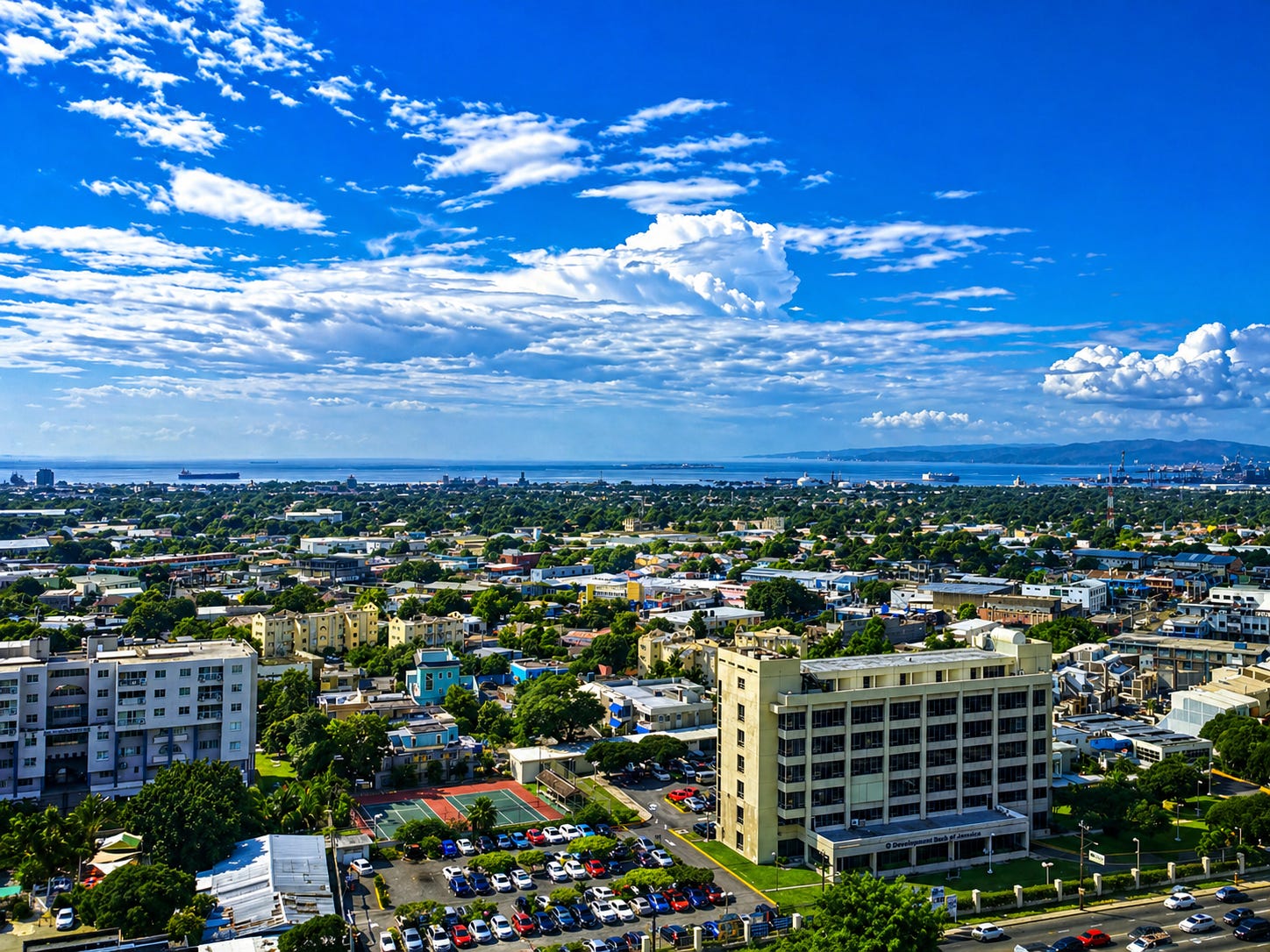
Kingston is facing a convergence of economic pressure, infrastructure strain, and post-hurricane rebuilding as the city adjusts to rising costs and shifting global conditions. Six months after Hurricane Melissa, the Jamaican capital continues to navigate recovery alongside broader challenges tied to inflation, housing supply, and international market forces.
Across the city, the effects are visible in daily life. Food, transport, and housing costs have risen, while major infrastructure systems, from roads to water supply, are under increasing pressure. At the same time, government investment in housing and logistics is accelerating, reflecting a wider effort to reposition Kingston as both a more resilient city and a more competitive commercial hub.
What is emerging is not a city in crisis, nor one in straightforward growth, but one undergoing a complex adjustment shaped by local realities and global influences.
Kingston is a city that has never quite revealed itself all at once.
It unfolds in layers. Along the harbour where cranes rise against the heat. Through the dense weave of streets where commerce, movement, and memory intersect. Up into the hills, where the air shifts and the city feels momentarily distant, even as it continues to expand below.
Today, those layers are under pressure.
Not in the dramatic sense of a single event, but in the accumulation of forces that are reshaping how the city functions, how it grows, and how it is lived in. Kingston, Jamaica’s administrative and commercial capital, is moving through a moment that feels less like a turning point and more like a quiet recalibration.
The signs are not always obvious, but they are everywhere.
Six months after Hurricane Melissa struck the island, the imprint of the storm is still visible, not only in the physical landscape but in the way the city now thinks about itself. Across Jamaica, tens of thousands of homes were damaged, infrastructure was tested, and the limits of resilience were exposed. In Kingston, where the impact was less severe than in other parishes, the effect has been more subtle but no less significant. It has altered the conversation.
Rebuilding is no longer just about replacing what was lost. It is about questioning what should exist in the first place. Hospitals, drainage systems, housing developments, and utilities are all being reconsidered through the lens of durability, cost, and future risk. Plans for critical infrastructure, including the redevelopment of Kingston Public Hospital, are being framed with a new sense of urgency, shaped as much by climate reality as by public need.
At the same time, the cost of living continues to press quietly but firmly against daily life.
Inflation, influenced by storm recovery and wider global forces, has moved from policy discussion into lived experience. Food prices, transport costs, and housing expenses have all edged upward, not dramatically in isolation, but enough in combination to change behaviour. For many households, the margin between stability and strain has narrowed.
These pressures are not entirely of Kingston’s making. They are carried in through global currents. The ongoing war in Ukraine, shifts in energy markets, and tighter financial conditions internationally continue to shape the cost of imports, the availability of capital, and the broader economic climate. Jamaica, like many small economies, absorbs these changes quickly.
And yet, Kingston is not simply reacting. It is positioning itself.
There is a growing coherence to the way the city is being discussed at policy level. Housing supply has emerged as a central concern, with significant public investment directed toward new development and subsidies. The argument is straightforward. Demand exists. The task is to meet it. But the reality is more complex. Land availability, infrastructure capacity, construction costs, and financing all interact to slow delivery, even as need becomes more visible.
Elsewhere, the city’s role as a logistics and commercial hub is being reinforced. Investment in port infrastructure, industrial zones, and related facilities reflects a long-standing ambition to anchor Jamaica more firmly within global trade networks. Kingston’s harbour, one of the largest natural harbours in the world, remains both an asset and an anchor point for that ambition.
There is a sense that the city is being drawn outward and inward at the same time. Outward, toward global relevance. Inward, toward the realities of how people live within it.
On the ground, this tension is felt in more immediate ways.
Traffic, for instance, has become a daily negotiation. Recent gridlock across parts of the city has drawn attention to infrastructure that has not kept pace with growth. Roads, transport systems, and planning frameworks are being tested by a city that has expanded beyond the assumptions built into them.
Security, long a defining aspect of Kingston’s identity, is showing signs of change. Recent figures indicate a reduction in serious crime in key areas, contributing to a broader national trend that has seen some of the lowest levels of violent crime in decades. The shift is notable, though fragile, and it sits alongside ongoing concerns about enforcement, trust, and long-term stability.
Taken together, these elements do not form a single narrative. They form a series of overlapping ones.
Kingston is a place where resilience is being redefined, not only in response to extreme weather but in the face of economic and social pressures that are less visible but equally persistent. It is a city where growth is occurring, but not evenly. Where opportunity exists, but is increasingly specific in where it can be found.
There is also a quieter transformation underway, one that is less often spoken about but no less important.
Connectivity. The ability to work, transact, and operate within a digital environment has expanded in recent years, supported by telecommunications infrastructure that continues to improve. This has allowed parts of Kingston’s economy to function with a degree of flexibility that was previously limited. It has also begun to shift expectations, particularly among younger professionals and businesses that are less tied to traditional structures.
What emerges from all of this is not a city in crisis, nor one in uncomplicated growth.
It is something more measured.
Kingston, in this moment, is adjusting. Testing its systems. Reassessing its priorities. Absorbing both local and global pressures while attempting to shape a path forward that is sustainable, both economically and physically.
It is a process that does not lend itself to headlines.
There is no single announcement that captures it, no single project that defines it. Instead, it is visible in fragments. In the cost of a meal. In the time it takes to cross the city. In the design of a new building. In the quiet recalibration of what is considered possible.
For those who live in Kingston, these shifts are not abstract. They are immediate, practical, and ongoing.
And for those looking in from the outside, whether as investors, policymakers, or observers, the challenge is not simply to see the city as it is, but to understand what it is becoming.
Because Kingston has always been more than a capital.
It is a place in motion.
And right now, that motion is being shaped by forces that are only just beginning to reveal their full extent.